Incremental Learning in Practice: From Concept to Real-world SAR Target Recognition

Modern machine learning systems are often trained under an unrealistic assumption: that all data and all classes are available upfront. In real operational environments, however, data arrive sequentially, new categories emerge over time, and storing or revisiting past data is often infeasible due to memory, privacy, or security constraints.
This gap between static training and dynamic deployment is where incremental learning becomes essential.
Incremental (or continual) learning refers to a model’s ability to learn new classes over time without forgetting previously acquired knowledge. The central challenge is catastrophic forgetting: when adapting to new data causes a severe drop in performance on earlier tasks. Addressing this problem is critical for AI systems, particularly in safety-critical and data-constrained domains such as remote sensing and defense.
Balancing Stability and Plasticity
Incremental learning is built around a key trade-off:
- Plasticity: The model’s ability to quickly learn new information.
- Stability: The model’s ability to preserve previously learned knowledge.
A highly plastic model adapts fast but forgets easily, while a highly stable model remembers well but struggles to incorporate new classes. Effective incremental learning methods aim to strike a balance between the two.
Common strategies include:
- Regularization-based methods that constrain how much important parameters can change over time.
- Replay-based methods that keep a limited buffer of past data to retrain on.
- Prototype-based methods that store compact representations (prototypes) of each class instead of full datasets.
Each family of methods makes different trade-offs in terms of memory usage, computational cost, and robustness.
Why Incremental Learning is especially challenging for Synthetic Aperture Radar (SAR)
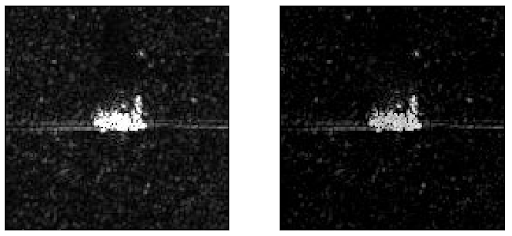
SAR imagery poses additional difficulties beyond standard vision tasks. SAR images are affected by speckle noise, exhibit high intra-class variability, and often show low inter-class separability. At the same time, real-world SAR applications, such as surveillance, maritime awareness, or target recognition, naturally evolve over time, with new targets, platforms, or operating conditions continuously introduced.
Most existing incremental learning approaches either:
- Rely on storing exemplars from previous tasks (which may be impractical), or
- Ignore SAR-specific challenges such as noise and domain shifts.
This motivated our work on IncSAR, an incremental learning framework explicitly designed for SAR target recognition.
IncSAR: A Dual-Fusion Incremental Learning Framework
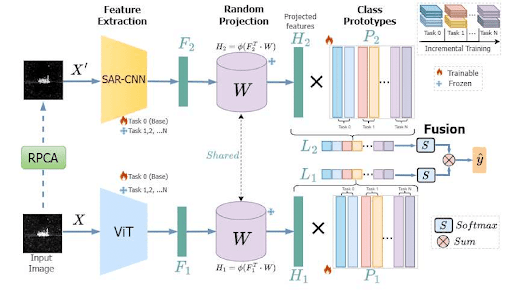
The IncSAR framework [1] was proposed as a comprehensive, class-prototype based incremental learning method for SAR target recognition. Instead of storing past images, the system maintains compact class representations (prototypes) that are updated as new tasks arrive. This design significantly reduces memory requirements while remaining effective against forgetting.
At a high level, IncSAR is built around three key ideas:
- Robust feature extraction for SAR data
- Complementary representations through dual fusion
- Stable incremental classification via prototype learning
Dual Fusion: Combining Global and Domain-specific Features
A core design choice in IncSAR is a dual-branch architecture:
- A pre-trained Vision Transformer (ViT) provides strong global and transferable representations.
- A custom lightweight CNN (SAR-CNN) is trained to capture SAR-specific spatial and textural characteristics.
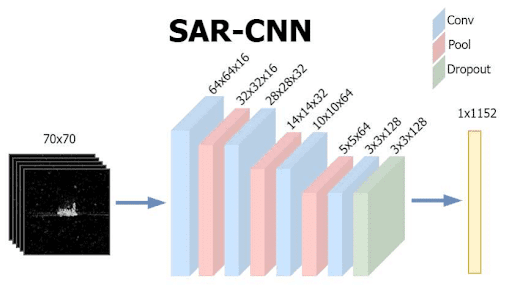
Rather than forcing a single backbone to handle all aspects of the problem, IncSAR fuses these complementary representations at a late stage. This allows the framework to benefit from both general semantic features and domain-specialized cues, which is particularly important for SAR imagery.
Handling Speckle Noise with Learning-based RPCA
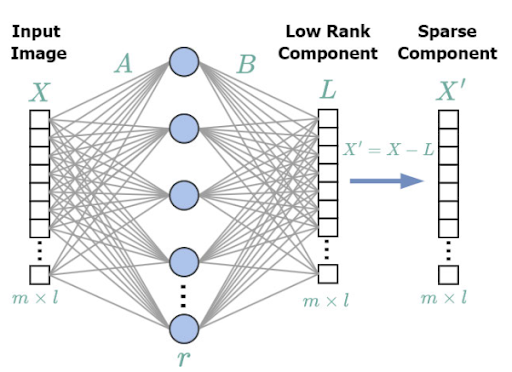
Speckle noise is a defining characteristic of SAR images and can severely degrade feature quality. IncSAR explicitly addresses this by incorporating a neural network approximation of Robust Principal Component Analysis (RPCA) as a preprocessing module.
This component decomposes SAR images into low-rank and sparse components, effectively suppressing noise while preserving target structure. Importantly, the RPCA module is trained once during the base task and then frozen, ensuring no added instability during incremental updates.
How IncSAR Performs in Practice
Across multiple benchmark datasets, including MSTAR, SAR-AIRcraft, and OpenSARShip, IncSAR consistently:
- Achieves state-of-the-art accuracy in class-incremental SAR recognition
- Exhibits minimal performance degradation as new classes are added
- Generalizes well across datasets and domains
- Remains effective even under limited training data conditions.
In a realistic scenario where new classes from OpenSARShip are introduced in the last incremental tasks, IncSAR maintains high average accuracy around 98.6% and keeps performance drop significantly lower than strong baselines, such as HPecIL [2] and ECIL+ [2]. The proposed framework not only performs well on the initial MSTAR tasks, but also adapts effectively to ships added later, despite their different distribution and target appearance. The IncSARLite variant performs similarly, reaching close to 99% average accuracy and maintaining a low forgetting rate, confirming that even the more compact design offers robust generalization.
Why This Matters for SAR-Automatic Target Recognition (ATR) Systems
From an application perspective, the properties demonstrated by IncSAR translate to practical advantages in real SAR-ATR systems. The exemplar-free design means that the framework does not require storing past training samples, which simplifies data management, alleviates privacy concerns and reduces memory usage. Instead, the system maintains class prototypes and updates them incrementally, allowing it to incorporate new classes while retaining strong performance on previously learned ones.
The very low catastrophic forgetting observed in experiments implies that a deployed system could be updated over time as new target types become relevant, without the need for full retraining or access to all historical data. This is particularly important in defense, maritime surveillance and disaster response, where new object categories may appear and where continuous operation is critical. At the same time, the RPCA-based despeckling and SAR-CNN branch directly address the unique noise characteristics of SAR imagery, improving robustness in challenging conditions. Future directions include reducing computational overhead, improving cross-domain adaptation, and extending these ideas beyond classification to detection and tracking tasks in SAR imagery.
We would like to acknowledge funding by the FaRADAI EDF project.
Code
Our code is publicly available here
References
[1] Karantaidis, G., Pantsios, A., Kompatsiaris, I., & Papadopoulos, S. (2025). Incsar: A dual fusion incremental learning framework for sar target recognition. IEEE Access.
[2] Tang, J., Xiang, D., Zhang, F., Ma, F., Zhou, Y., & Li, H. (2022). Incremental SAR automatic target recognition with error correction and high plasticity. IEEE Journal of Selected Topics in Applied Earth Observations and Remote Sensing, 15, 1327-1339.

The content of this post is licensed under a Creative Commons Attribution-NonCommercial-ShareAlike 4.0 International License (CC BY-NC-SA 4.0).

Karantaidis George
Postdoctoral Researcher - Project Manager
My main research interests lie in the areas of deep learning, signal processing, and information forensics.